



Table of contents
If you're a hardware engineer in a startup, chances are procurement is a task you inherited, not one you asked for. You're juggling design, testing, maybe even manufacturing. But suddenly, you're also responsible for buying parts, managing suppliers, and tracking BOMs. You know it's important, you just don't want to screw it up.
This guide is for you. It’s a no-fluff walkthrough of what a modern procurement stack looks like for a hardware startup: what to do early, what to do later, and how to avoid mistakes that delay builds, waste money, and burn out your team.
What is a Procurement Stack?
Your procurement stack is the combination of tools, workflows, and people responsible for sourcing and managing components. It ensures the right parts arrive at the right time.
A modern stack might include:
- A spreadsheet (yes, that’s still fine early on)
- A BOM management tool like PartsBox or OpenBOM
- A procurement-as-a-service provider like Cofactr (which includes BOM management and one-cart checkout)
- An ERP/MRP system like Odoo or ERPNext
- A component receiving, warehouse, and kitting plan - also part of Cofactr
- External partners: contract manufacturers, distributors, sourcing agents
The goal isn’t to buy tools. It’s to keep the stack aligned with your phase and your bandwidth.
Phase 1: Product Development (R&D and Initial Prototypes)
You’re building a few boards. You don’t need procurement software. You need to move fast and keep things simple.
Start With Spreadsheets, But Do It Right
Excel or Google Sheets is enough. Just be consistent:
- Use manufacturer part numbers (MPNs)
- Include descriptions, quantity per, reference designators.
- Optional: add prices, lead times, vendors, RoHS
- Pro tip: start using internal part numbers, it will make migration to ERP easier
- Manage versions carefully
Here’s a great template to get you started.
Where to Buy
Use authorized distributors like DigiKey and Mouser, or search aggregators like Octopart for what they don't carry. And when you're ready to streamline your purchasing, Cofactr consildates it all into one cart for easy checkout. At this stage, availability and ease of use beat cost.
Buy parts yourself. Save receipts. Keep records.
Prototype Assembly: In-House or Outsource
Hand-assemble if you can. Otherwise, use a local CM who does quickturn to source and build your prototypes. It’s faster and often less error-prone, and it’s comforting to be able to just drive over if necessary.
Design for Availability
Choose components with multiple sources and long life cycles. Skip the obscure stuff. You’re not optimizing yet, you’re avoiding future headaches.
Start Building Supplier Accounts
Create logins with major distributors. Record your purchases. If you expect to spend more than $25,000 at a distributor, ask for an account rep. If you expect to spend more than $50,000 in the next year, start a relationship with Arrow and Avnet. These small steps help later.
Phase 2: Prototyping and NPI
Now you’re building tens or maybe hundreds of units. The BOM is stabilizing. Procurement starts to get more important.
Upgrade Your BOM Management
Consider OpenBOM or PartsBox. They solve version control problems and make purchasing easier.
Still on spreadsheets? You’ll need scripts or macros to keep things organized.
Consolidate Your Buys
If you need to build 50 units, don’t order parts 50 times. Buy enough components to cover production, attrition, testing, and spares.
Check lead times early. Order long-lead parts first.
Use Procurement-as-a-Service
Skip hiring and prepare for the future with Cofactr, a pay-as-you-go platform that can manage sourcing, quoting, alternates, and even warehousing and kitting. Cofactr’s automatic 3-way matching of purchase orders, packing lists, and invoices makes record keeping and compliance tracking a breeze.
Work With a CM, But Stay Involved
A CM can handle procurement for you. But give them an AVL and highlight critical parts. Get regular updates on lead times and risks. Remember they are a for-profit enterprise and their profit comes from material markup, not labor. So maintain control of your material costs.
Start Getting Quotes
Request volume quotes on expensive parts. Develop relationships with your key component manufacturers so you secure the most favorable cost, terms, and availability. Consider cost-saving alternatives. Use external help if needed, or just outsource the quoting to a professional team like Cofactr’s to get years of experience on your side.
It’s Time to Level Up If:
- Each BOM has 100+ line items and you have multiple BOMs.
- Engineers are losing time to sourcing
- Part deliveries are slipping
- You’re planning a production ramp
If yes to more than one, move beyond the Phase 2 stack.
Phase 3: Production and Scaling
You’re moving toward producing hundreds or thousands of units consistently. Procurement now affects your margins, timelines, and sanity.
Implement MRP or ERP
Use Odoo, ERPNext, or similar. They help you plan, track, and reorder accurately and integrate with accounting and warehouse. Minimize customization if you plan on migrating to more robust ERPs like NetSuite in the future.
But they only work if your BOM and inventory data are clean.
Hire a Pro
Bring in a contract supply chain expert. Let them:
- Negotiate supplier terms
- Set up processes
- Build your logistics plan
If your team is new to procurement, you can reasonably expect a full time pro to save you 20% while costing you around $100,000. So if you're spending more than $500,000 in material cost a pro is probably worth it.
Use PaaS
If you use a PaaS like Cofactr you can skip hiring a procurement pro. Expertise across all the commodities comes baked in with Cofactr so no need for hiring. And with Cofactr, no need for a warehouse either.
Lock in Supplier Terms
Negotiate volume pricing yourself. Get lead time commitments. Build relationships. Sell suppliers on your company, good suppliers offer better terms if they believe in your growth.
Logistics and Compliance
If you’re using contract manufacturers you’ll need:
- ESD safe component handling
- Moisture-sensitive part handling
- Kitting
- Inventory tracking
- Traceability, especially if you’re in defense or medical
- Compliance savvy
Cofactr offers certified 3PL on both coasts for storage, kitting, and shipping to you or your CM.
Production in Asia
If you’re manufacturing overseas or shipping globally, you’ll also need:
- Freight forwarding
- Customs brokers
- Import/export compliance savvy
Asian CMs might reduce your cost, but tariffs and rising labor costs in Asia are reducing the savings. If you do go to Asia be ready for longer lead times, less transparency, and language barriers.
When to Invest More in Procurement
These are the warning signs:
- Prepping for volume builds
- Raised funds to scale
- Engineers are bogged down in admin
- Multiple suppliers, no clear process
- Frequent delays or shortages
Don’t wait. Fix it before it breaks.
In-House vs. Outsourced Procurement
Early on, outsource:
- It’s flexible and affordable
- You get expert help instantly
- You avoid fixed overhead
As you grow, bring in-house:
- Supplier management
- Focus on deeper supplier relationships, not low-value task execution
Many startups split it. Keep strategic work in-house. Outsource routine purchasing.
Your Procurement Roadmap
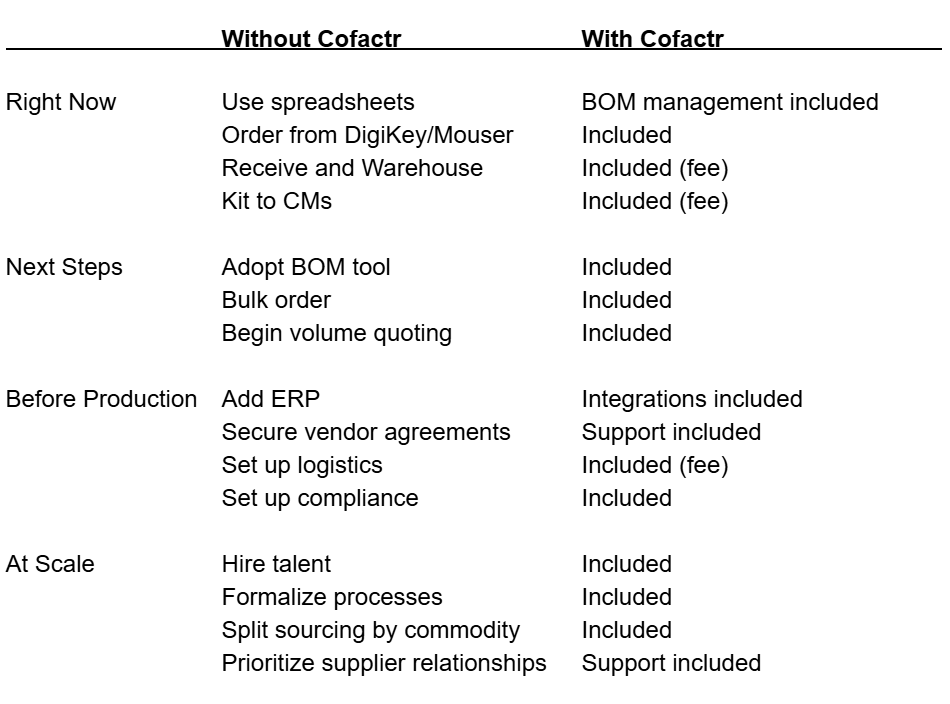
Procurement matters. But it doesn’t have to dominate your time, kill your schedule, or ruin your budget. Keep it lean. Use external help. Invest at the right moments.
Ready to let Cofactr handle sourcing, negotiations, storage, kitting, and delivery while your team focuses on building products? It’s free to get started with Cofactr today.
Frequently Asked Questions
What is a modern procurement stack for hardware startups?
A modern procurement stack combines tools, workflows, and partners that help startups source components, manage BOMs, track inventory, and ensure parts arrive on time without overwhelming engineers.
How to manage procurement during early product development?
Start with simple spreadsheets, track manufacturer part numbers, manage versions carefully, buy from authorized distributors, and prioritize speed and availability over cost optimization at the prototype stage.
Why does procurement often fall on hardware engineers?
In early-stage startups, engineers inherit procurement because teams are small, priorities are speed and execution, and hiring dedicated supply chain staff usually happens much later.
Can I rely only on spreadsheets for BOM management?
Yes, spreadsheets work early if maintained carefully, but as BOMs grow and versions multiply, dedicated BOM tools reduce errors, save time, and improve purchasing accuracy.
What is procurement-as-a-service and when should I use it?
Procurement-as-a-service platforms handle sourcing, quoting, alternates, and logistics, making them ideal during prototyping, NPI, or scaling without hiring full-time procurement staff.
When does it make sense to adopt ERP or MRP systems?
ERP or MRP systems become valuable when producing hundreds of units, managing inventory across builds, integrating accounting, and planning reorders based on accurate, clean BOM data.
Where to buy electronic components during early stages?
Authorized distributors like DigiKey and Mouser are best early on, while aggregators help find availability, ensuring reliability, traceability, and faster builds without unnecessary sourcing complexity.
Who should own procurement as the company scales?
As volume grows, procurement should shift to experienced supply chain professionals who can negotiate pricing, manage suppliers, and design processes that protect margins and timelines.
Is it better to outsource or keep procurement in-house?
Early-stage startups benefit from outsourcing procurement for flexibility and expertise, while later stages often bring strategic supplier management in-house and outsource routine purchasing tasks.
Why is designing for component availability important?
Designing with widely available, multi-sourced components reduces future shortages, lowers risk during scaling, and prevents costly redesigns caused by obsolete or constrained parts.
Do I need to worry about logistics and compliance early?
Basic logistics and compliance matter early, but they become critical during production, especially with contract manufacturers, regulated industries, global shipping, and traceability requirements.